
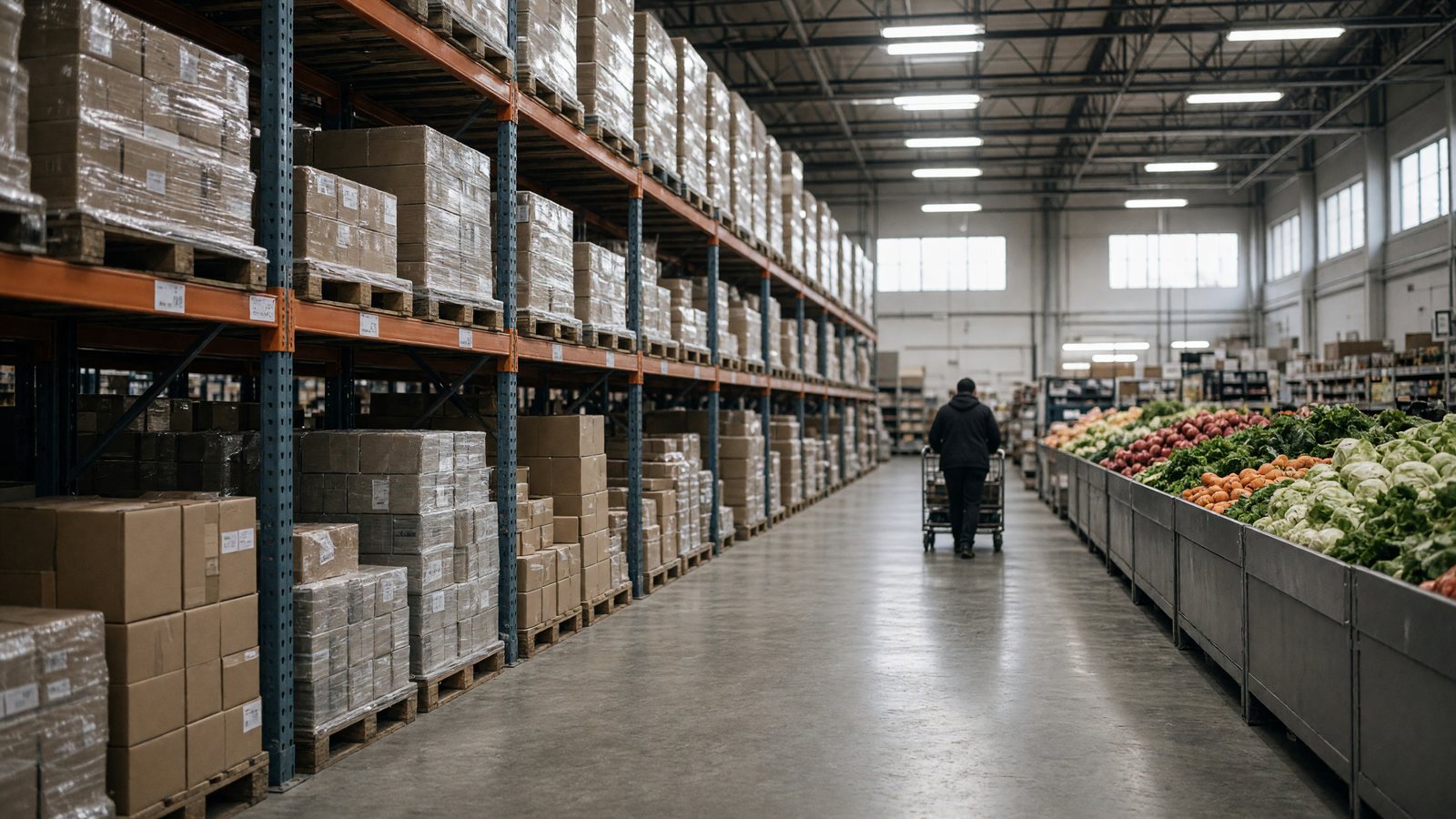
Costco grocery share has passed Kroger’s, putting the warehouse club second in U.S. food and beverage spending while Walmart widened an already dominant lead. Numerator’s Retail Market Share tracker for the 12 months ending September 30, 2026, puts Costco at 8.4% and Kroger at 8.2%. Business Insider reported that households facing higher costs for gas, housing, and insurance are looking for grocery savings.
Key Takeaways
Costco Grocery Share Passes Kroger
Supermarket News and Perishable News reported on October 28 that Costco had overtaken Kroger as the second-largest U.S. grocery retailer by spending share, with gains in the West. Business Insider said the 8.4% reading was half a percentage point above a year earlier, while Kroger fell 0.2 points. Costco has gained share steadily over two years as Kroger and Albertsons shrank.
Albertsons slipped 0.1 points to 4.5%. Publix held fifth place in grocery at 4.1%, and Numerator said the chain has maintained its position while other established supermarkets lost ground. The estimates use Numerator’s Total Commerce Panel, which tracks purchasing across more than 50,000 U.S. retailers and excludes alcohol and cannabis.
| Retailer | Food and beverage share | Change vs. prior year |
|---|---|---|
| Walmart | 20.3% | +0.2 points |
| Costco | 8.4% | +0.5 points |
| Kroger | 8.2% | -0.2 points |
| Albertsons | 4.5% | -0.1 points |
| Publix | 4.1% | Not reported |
Walmart Still Holds a Fifth of Grocery Spend
Walmart’s food and beverage share rose 0.2 points to 20.3%, more than twice Costco’s 8.4%. In broader CPG, Walmart held 20.8%, up 0.1 points year over year, Perishable News reported. The CPG gain is uneven: share rose more than 0.6 points among Gen Z and millennial shoppers and fell 0.3 points among boomers.
CPG Dollars Concentrate at Three Retailers
Beyond the grocery aisle, CPG spending is concentrating at Walmart, Amazon, and Costco, while Kroger and Albertsons keep losing ground. Amazon + Whole Foods gained 0.7 points of CPG share year over year, the largest increase of any major retailer, to 8.1%, 0.1 points behind Costco’s 8.2%. Kroger’s CPG share is 6.7%, fourth in Numerator’s top five, behind Amazon + Whole Foods.
Over two years, Numerator’s tracker shows Amazon + Whole Foods and Costco gaining 1.4 and 0.7 CPG points, respectively, and each gaining 0.7 points of grocery share. In the latest year, Costco’s CPG share rose 0.5 points, led by the West at +0.8 points, while Sam’s Club lost 0.2 points nationally and holds 3.6%.
Price Pressure Has Not Reversed the Slide
The share shift coincides with fresh inflation from last year’s trade war and this year’s conflict with Iran, Business Insider reported. Costco has kept prices steady this year, though its leaders are watching cost pressures. Groceries have not yet been significantly affected by rising diesel and transportation costs.
A Deutsche Bank note, as reported by Business Insider, said Walmart is bracing for an impact that would outweigh the benefit of tariff refunds received this year. Walmart had initially planned to invest some of those refunds in price cuts. The note also said that when Walmart raises prices, competitors do too, and Walmart typically remains the lower-priced option.
Business Insider reported that Kroger named Greg Foran, who formerly led Walmart’s U.S. business, as CEO this year. His focus is a $5 billion effort to lower prices and tighten operations, including significant corporate workforce cuts over the next few years and ending supplier contracts that are not delivering a good enough deal.
Wisevoter noted that the effort has not yet shown up in the share data. Albertsons, the same Business Insider report said, is making several significant adjustments to its employee benefits package to manage rising healthcare costs.
What Grocery Share Shifts Mean for Marketers
The implication for retail and e-commerce executives is that format is now doing as much work as banner. Warehouse clubs and mass merchants are taking food dollars from conventional grocers while Amazon closes on Costco in wider CPG. That combination pressures supermarket retail media, private-brand price gaps, and the terms suppliers can hold.
Numerator refreshes these shares every quarter. Three markers in the next update:
- Whether Kroger’s $5 billion price-and-operations plan shows up in food and beverage share.
- Whether Walmart still funds cuts if diesel and freight costs outweigh this year’s tariff refunds.
- Whether Amazon + Whole Foods closes the 0.1-point CPG gap, and whether Walmart’s gains stay concentrated among younger shoppers.
Suppliers comparing banners can also track how Walmart prices seasonal food, including its holiday meal basket. If clubs and mass banners keep holding price while supermarkets restructure, suppliers should expect tougher cost talks and more volume moving through membership and mass formats.
